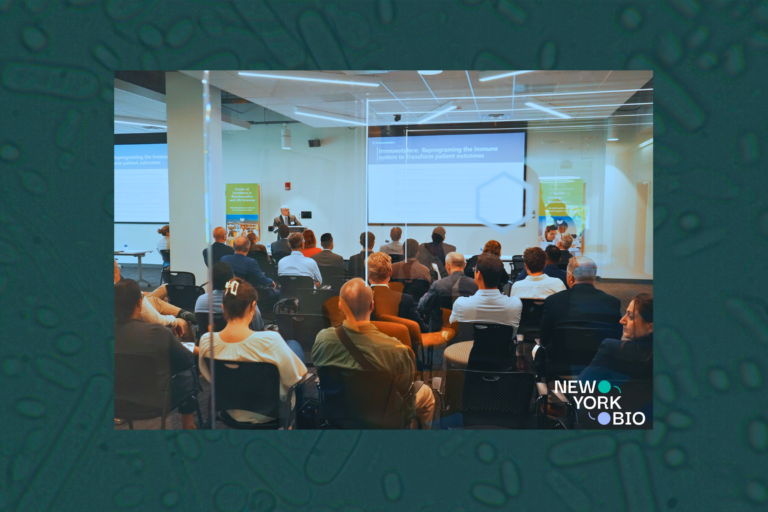
Building the Connections That Move New York Forward: Takeaways from NewYorkBIO’s Innovation Summit
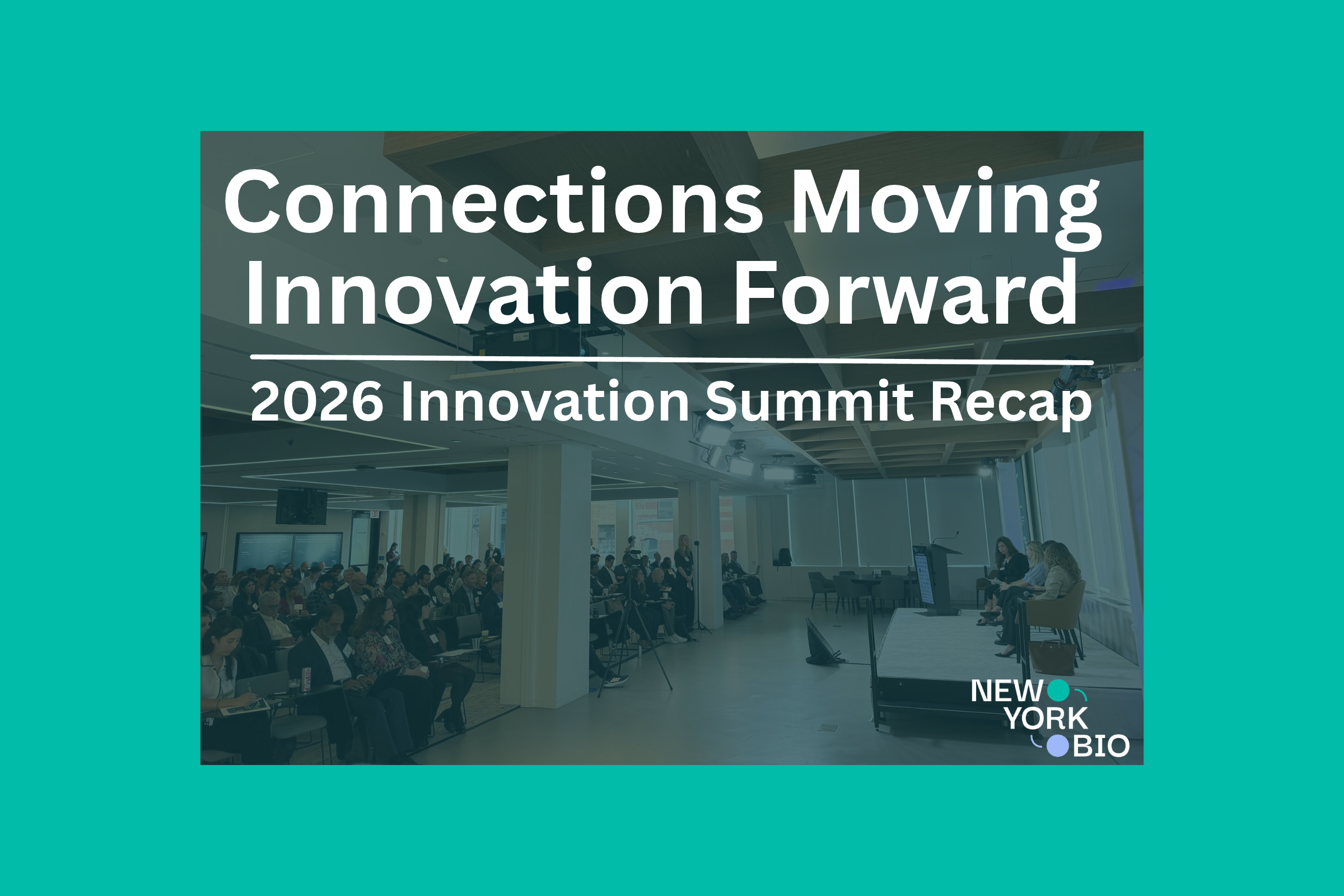
How does New York translate its assets in talent, capital, and infrastructure into innovative results?
That question ran through every session of NewYorkBIO’s Innovation Summit on September 30, 2026. Panels with diverse representation in biotech, financing, academia, law firms, economic development, and patient advocacy covered hot topics from effectively collaborating on federal drug and patient policy to women’s health and translating pilots, conversations, and academic research to available treatment.
Opportunities in research translation and capital sourcing
Seema Kumar, CEO of Cure led discussion on the fragmented challenge of drug discovery between academia and industry, where too many promising discoveries stall in that handoff. Cure introduced the Innovation Index, which measures the impact and efficacy of translation on a national level. Kumar was joined by Dr. Miriam Bredella of NYU Langone Health and Dr. Erik Lium of Mount Sinai Health System to share examples and opportunities to continue elevating New York’s status as a global leader in biomedical innovation. They called for earlier conversations, like NYU’s bench-to-bedside program, flexibility in partnership contracts, and reverse engineering experiments bedside to bench around what will translate to a clinical trial.
Just as research should consider translation capabilities early, finance partners also strongly recommend early planning with financing, legal and risk management. Larry Ysuf of EY, Sam Landsberg of Royalty Pharma, and Michael Tollini of Cooley discussed the need for milestone-driven resources and incentives that reduce risk for early companies and made the case for royalty financing as part of a new biotech funding playbook. It suits founders who don’t want to give up ownership or equity. Royalty investors judge the quality of the drug, its likely impact for patients and physicians, the clinical data and how the innovation fits its competitive landscape.
There is progress on defining the biology and development paths, but clinical trial design can still create headwinds.
Significance of Policy & Regulatory Changes
Anna Abram of Akin, Lowell Schiller of USC Schaeffer Institute, Julie Tierney of Leavitt Partners, and Angela Wiles of Pfizer shared insights about the upcoming reauthorization of the Prescription Drug User Fee Act (PDUFA). Congress reauthorizes it every five years to support both accountability and innovation at the FDA and September 2027 is the target month. “Reauthorization is a reflection of where the conversation is with drug development [at that moment in time],” Abram stated.
The industry’s priorities are a modern, efficient FDA to ensure scientific breakthroughs can become real treatments improving patients’ lives. That means fixing pain points such as first-cycle reviews and turning successful pilots into standard practice. Pharmaceutical policy runs through the House Energy and Commerce Committee, and a new Congress arrives in January 2027. With new members, conversations can start over and institutional knowledge can be lost. That makes this a critical window for education and advocacy.
Regulation also shaped the women’s health discussion with Linda Malek of Crowell & Morning, Laura Katz of Helenia, Geena Shah of Evvy and Dr. Julia Owens of Basking Biosciences. The FDA’s updated approval approach for osteoporosis has eased clinical trial requirements. But products created by Helaina, a women’s nutrition company, are regulated as supplements. Panelists asked how to build a path that shows regulatory rigor and outcomes “without pushing a square peg into a round hole.” Dr. Owens called for women’s health incentives modeled on the Orphan Drug Act, including research funding.
Talent + Manufacturing Competitiveness
Talent is the engine for growing all businesses, especially the life sciences. Jeanny Pak of NYCEDC defined success as diversity in talent, longevity in careers and easier access to the field. Empire State Development’s Jeff Janiszewski, Joan Spivak, and Loretta Beine were joined by Dr. Donna Barron of Hudson Valley Community College and Dr. Jose Manny Otero or Lexeo Therapeutics to discuss workforce’s vital role in the ecosystem and the impact with manufacturing, where the race for both people and production capacity is heating up. Many treatments come through foreign manufacturing, which has sparked initiatives reshoring to the U.S. In New York state, Empire State Development highlighted a 0% corporate tax rate for qualifying manufacturers, plus Excelsior and R&D tax credits available to startups for five years. Lexeo Therapeutics described the opportunity firsthand. The company is looking for clinical GMP manufacturing capacity in New York. “We’ve been able to accelerate because we’re here in NYC,” said Dr. Otero. Lexeo is now discovering the state’s “extended ecosystem” upstate.
Incentives only go so far without the people to run the lines. Manufacturers need technicians, and CMC scientists remain a niche, hard-to-find specialty. The path forward runs through partnerships that already exist. Hudson Valley employers work with community colleges in the Adirondack region and see overlap with CHIPS-related workforce efforts. Other specified opportunities included:
- Classification. Biomanufacturing often gets lumped in with high tech, even though it makes complex products that are not necessarily high-volume.
- Capacity and home base. New York needs more CDMOs (contract development and manufacturing organizations) and potentially a campus centralizing capabilities.
“Community really matters to be seen”
Jennifer Hawks Bland, CEO of NewYorkBIO, and Dr. Julia Ownes, CEO of Basking Biosciences, spoke firsthand about their experiences being the only women in a room, even sometimes among 80 CEOs at an investor dinner. Women lead differently, they said, and they still must navigate unconscious bias. Women-led companies outperform, yet their leaders are not promoted at the same rate. The call to action was to keep supporting women CEOs and to change the perceptions that hold them back.
Patients and advocates also shared their stories, redefining progress through their lens. Sean Converse, a patient with IgA nephropathy described graduating from college. Jennelle Stephenson, a sickle cell patient described living without pain since treatment. Alissa Kantowitz, a mother who lost her daughter to influenza turned that loss into advocacy through Families Fighting Flu, identifying systemic gaps and helping move a policy vote on flu vaccination. Panelists also asked researchers and companies to use shared, everyday language rather than clinical jargon. The patient panel reminded everyone why this work matters. “Innovation means possibility.”
What’s next for New York Bio Connect
One year in, the summit confirmed why New York Bio Connect exists. New York is rich in talent, science or ambition. What it needs is the connective tissue that links students to employers, researchers to founders, upstate to NYC, and patients to the people building their treatments. That is the work Connect already does every day:
- Talent: the Connect job board. Member companies post openings, and students and job seekers find roles across the state, including the technician and specialist roles manufacturers say they need most.
- Starting early: Funding and Programs. Programs like NewYorkBIO’s Mini Pitch Days give early-stage founders real-time feedback from judges and coaching from mentors, building investor and partnership readiness before they need it.
- NYC to upstate: Statewide events. Connect Briefs organize the ecosystem’s resources so founders can find programs, partners and capacity beyond their own region. Our in-person events bring those regions into the same room.